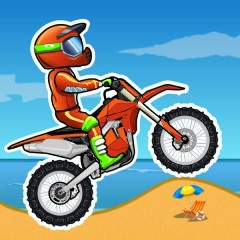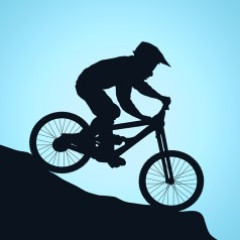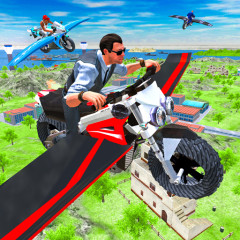
Bike Obby Draw Pencil blends bike handling with path-drawing mechanics. You must maintain your balance while creating the perfect route for your character.
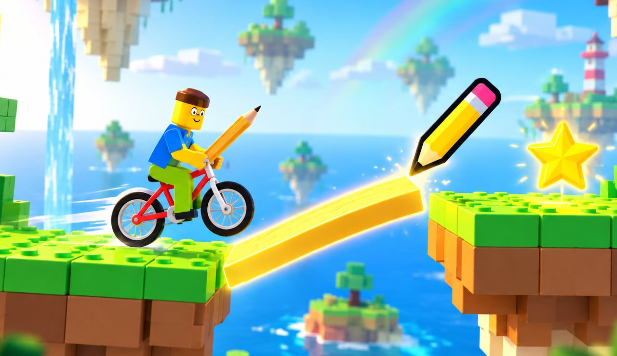
The appeal of Bike Obby Draw Pencil lies in the combination of terrain analysis and active control. Every stroke directly affects the bike's movement; a path that is too steep or has a gap can easily cause trouble for your character.
Unlike standard racing games, Bike Obby Draw Pencil doesn't provide a pre-built track. You may encounter gaps or impassable areas ahead that cannot be crossed through normal movement alone.
This is where the drawing tool becomes essential. You need to draw path segments to create bridges or surfaces that allow the bike to keep moving. This construction aspect turns every level into a mini-puzzle where you must quickly decide where and how to draw.
Simply drawing a connecting line doesn't guarantee the bike will make it across. The shape and slope of your drawing affect how the bike moves.
A path that is too steep can cause the bike to lose its balance or struggle to land properly. Conversely, if the path is too low or misaligned, the wheels might not be able to roll forward.
So, observe the bike's position and the surrounding terrain before you start drawing. Sometimes, a short stroke in the right spot is more effective than a long, sprawling path.
The task doesn't end once the path is drawn. As the bike moves, you must continue to control it to prevent it from tipping over or falling off the terrain. Pay special attention to the bike's tilt angle when traversing slopes or landing after a jump. Losing your balance could prevent you from continuing the journey, even if the path ahead has already been drawn.
This is what makes Bike Obby Draw Pencil more than just a simple line-drawing game; you must combine terrain analysis with bike control to successfully complete each level.
To clear each level, you need to observe the terrain and quickly draw suitable paths. Different situations require different approaches to ensure the bike moves steadily.
| Situation | Drawing Technique | Purpose |
|---|---|---|
| Small Gap | Draw a short line connecting both sides of the terrain. | Create a bridge so the bike can keep moving without falling. |
| Large Gap | Draw a long, relatively straight line that connects securely to both sides. | Help the bike cross a wide gap safely. |
| Different Heights | Draw a sloped path from the higher area down to the lower area. | Allow the bike to transition between different heights smoothly. |
| Need More Momentum | Create a moderate slope in the direction the bike is traveling. | Build momentum for crossing an obstacle or gap. |
| Bike Is Easy to Tip Over | Reduce the slope and avoid sharp angles or sudden changes in direction. | Keep the bike balanced while moving. |
| Obstacle Ahead | Draw a curved or sloped path to change the bike's approach. | Help the bike avoid the obstacle. |
| Misaligned Path | Draw toward the direction you want the bike to travel instead of connecting the points with a straight line. | Guide the bike back toward a safer route. |
| Narrow Section | Draw a path that is wide enough and avoid sharp curves. | Give the bike a more stable surface to ride on. |
Long, massive lines aren't always the best choice. Prioritize drawing lines that are just sufficient to create a stable path, especially when the bike is moving at high speed or is about to tackle an obstacle.
If you enjoy the thrill of creating your own paths to overcome challenges, be sure to check out Draw Race io, which combines racing gameplay with unique drawing mechanics.